Navigating the world of online growth can feel like a full-time job on top of actually running your company. For small business owners, the goal isn’t just to “be online”—it’s to be where your customers are, in a way that feels real, helpful, and accessible. In 2026, the internet is flooded with automated noise. To stand out on BeingExtrovert, you need to double down on human connection and smart, budget-friendly digital marketing services.
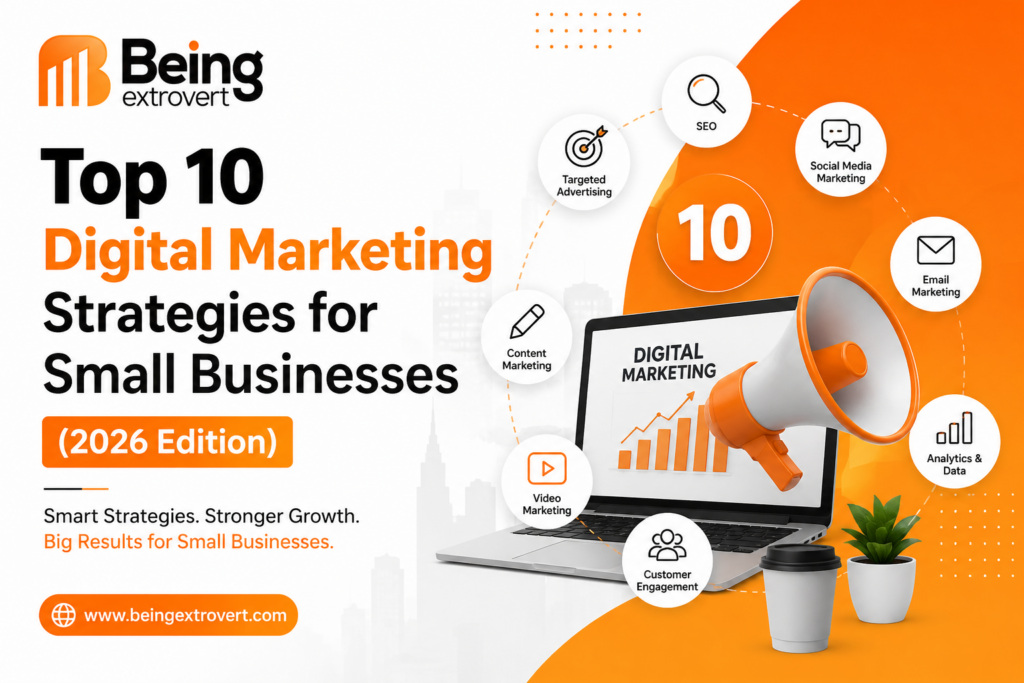
Here are the top 10 digital marketing strategies for small businesses that are actually moving the needle this year.
1. Hyper-Local SEO: Owning Your Neighborhood
If you run a brick-and-mortar shop or a service-based business, “near me” searches are your most profitable leads. Local SEO strategies for small business have shifted from simple keyword stuffing to “engagement signals.”
Google and other AI-driven search engines now look at how often people interact with your Google Business Profile. It’s not enough to just list your hours. You need to post real, unpolished photos of your team at work and respond to every single review—even the neutral ones.
Instead of targeting broad terms like “Best Bakery in New York,” try specific neighborhood keywords like “Best sourdough bread near West Village.” It’s a smaller pool, but the people searching are much more likely to walk through your door within the hour.
2. Social Search: The New Yellow Pages
People aren’t just scrolling through social media for entertainment anymore; they’re using it as a search engine. TikTok and Instagram are the new Google for the younger generation. Successful social media marketing for small business now requires “Social SEO.”
This means your captions need to be descriptive and keyword-rich. If you’re a florist, don’t just write “Pretty flowers!” as your caption. Instead, try “How to keep your spring peonies fresh in a small apartment.” By answering a specific question, you make your content discoverable to people who aren’t even following you yet. Vertical video remains the gold standard—keep it under 60 seconds and focus on being helpful rather than perfect.
3. Creative-Led Facebook Advertising
Facebook advertising for small businesses is still one of the best ways to reach a specific group of people. However, the strategy has moved away from manual “interest” targeting and toward “Creative-led growth.”
Meta’s AI is now smart enough to find your audience based on the content of your ad. If your ad shows a woman doing yoga, the algorithm will find people interested in wellness. The key is the “hook”—the first three seconds of your video or the first line of your text. If you don’t grab them immediately, your budget is wasted. Small businesses are seeing the best ROI by letting the algorithm do the heavy lifting while they focus on telling a great story.
4. High-Intent Google Ads
When someone searches for a plumber or a lawyer, they usually have a problem that needs solving immediately. Google Ads for small business allows you to show up at that exact moment of need.
To keep costs down, use “Negative Keywords.” These are words you tell Google not to show your ad for, such as “free,” “cheap,” or “jobs.” This ensures your budget is spent only on people ready to pay for your expertise. Also, look into Local Services Ads (LSAs). These appear at the very top of search results with a “Google Guaranteed” checkmark, which builds instant trust with local customers.
5. Segmented Email Marketing
Your email list is the only platform you truly own. Unlike social media, no algorithm can get between you and your subscribers. Effective email marketing strategies for small businesses in 2026 must move away from the “monthly blast” and toward personalization.
Start using “behavioral triggers.” This means if a customer looks at a specific service page on your website but doesn’t book, they automatically get a follow-up email a few hours later with more information or a small discount. Even a simple three-part “Welcome Sequence” for new subscribers can significantly increase your conversion rates without any extra daily work.
6. Authority-Building Content Marketing
Content isn’t about writing 500-word blog posts just to check a box. Content marketing for small business is about proving you are the local expert.
Focus on “Topic Clusters.” Instead of writing random articles, create one deep-dive guide (like “The Ultimate Guide to Home Maintenance in Seattle”) and then link smaller, specific posts to it (like “How to fix a leaky faucet”). This structure tells search engines that you have deep knowledge of your subject, which helps you rank higher than competitors who only post generic updates.
7. Nano-Influencer Partnerships
You don’t need a celebrity to promote your brand. In fact, influencer marketing for small businesses is often more effective when you go small.
“Nano-influencers” (people with 1,000 to 5,000 followers) often have much higher engagement rates because their followers actually know and trust them. Often, a local creator will be happy to work with you in exchange for a free product or a small fee. This builds “social proof” that feels like a recommendation from a friend rather than a paid commercial.
8. Conversational PPC Advertising
PPC advertising for small businesses is becoming more conversational. Instead of sending people to a long, boring contact form, try “Click-to-WhatsApp” or “Click-to-Messenger” ads.
For many small businesses, a quick “Hey, do you have any openings this Friday?” leads to a sale much faster than an email exchange. By meeting the customer where they are already chatting, you lower the barrier to entry and make the buying process feel personal.
9. Voice & AI Search Optimization
With the rise of voice assistants like Alexa and AI tools like Gemini, people are asking questions in full, natural sentences. Your website needs to “speak” like a human to be found.
The easiest way to do this is by creating a robust FAQ page. Use headers that are phrased exactly how a person would speak, such as “How much does a kitchen remodel cost in 2026?” or “Where is the best place to get a haircut in downtown?” By providing direct answers to these questions, you increase your chances of being the “featured snippet” at the top of search results.
10. Community-Led Growth
In an era of digital noise, community is the ultimate competitive advantage. The most successful small businesses treat their customers like a club rather than a transaction.
Encourage “User-Generated Content” (UGC) by asking customers to share photos of your product or service. You can even host small local events or webinars to build a face-to-face connection. When people feel like they belong to your brand’s community, they become your best marketers, bringing in new leads through word-of-mouth that no ad can beat.
Frequently Asked Questions (FAQs)
- How much should a small business spend on digital marketing? A good rule of thumb is to spend 5% to 10% of your gross revenue on marketing. However, if you are a new business, you might need to invest more time in “sweat equity”—like organic social media and networking—until you have the cash flow for paid ads.
- How long does it take for SEO to start working? SEO is a marathon, not a sprint. You can expect to see some initial movement in 3 to 4 months, but the real, life-changing results usually happen around the 6-to-12-month mark. The key is consistency.
- Do I really need a website if I have a strong Instagram page? Yes! You don’t own your social media followers; the platform does. If the app goes down or changes its algorithm, you could lose your entire audience overnight. Your website is your digital home where you control the entire experience.
- What is the biggest mistake small businesses make in digital marketing? Trying to be everywhere at once. It’s much better to be amazing on one or two platforms (like Google Maps and Instagram) than to have five dead accounts on platforms you don’t have time to manage.
- How do I know which strategy is right for my specific business? Think about how your customers find you. If they need you in an emergency (like a locksmith), focus on Google Ads and Local SEO. If they buy based on how things look (like a clothing brand), focus on Instagram and Influencer marketing.