Is SEO Worth It for Small Businesses? The Unfiltered Truth for 2026
If you’re running a small business in 2026, you’ve probably felt the squeeze. Between rising ad costs on Meta and Google and the constant noise of “the next big thing” in marketing, it’s hard to know where to put your money. You’ve likely asked yourself: Is SEO worth it for small businesses? Or is it just a black hole for your marketing budget?
Let’s be blunt. For some, SEO is the engine that drives 80% of their revenue. For others, it’s a frustrating, slow-moving expense. The difference usually comes down to strategy and expectations. selecting the right SEO services for small business can not only save you cost but can give you the expected results.
In this guide, we’re breaking down the real SEO ROI for small businesses, the actual costs, and whether “cheap” SEO is ever a good idea.
The Big Question: Does SEO Actually Increase Sales?
The short answer? Yes. But it’s not magic.
In 2026, over 53% of all trackable web traffic comes from organic search. If you aren’t visible when someone types a query into Google (or asks a voice assistant), you basically don’t exist for half of your potential market.
Why SEO is Profitable for Small Business
Unlike paid ads, which stop the second you stop paying, SEO is an asset. Think of it like buying a house instead of renting an apartment.
- Compounding Returns: Your efforts in Month 1 continue to pay off in Month 24.
- Higher Trust: Users generally trust organic results more than the “Sponsored” tags.
- Intent-Based Leads: When someone searches for “emergency plumber near me,” they have high intent. They aren’t just browsing; they are ready to buy.
Recent 2026 data shows that SEO leads have a close rate of roughly 14.6%, compared to just 1.7% for traditional outbound marketing (like cold calls or mailers). That is a staggering difference in efficiency.
The Benefits of SEO for Small Business
Beyond just “getting more clicks,” a solid SEO strategy changes the way your business operates online.
1. Leveling the Playing Field
Small businesses often can’t outspend giant corporations on TV ads or massive PPC campaigns. However, with local SEO, you can out-rank a national brand in your specific city. Google prioritizes relevance and proximity. If you’re the best-reviewed bakery in Karachi, Google wants to show you to the hungry person around the corner, not a massive chain.
2. Better User Experience (UX)
Google’s 2026 algorithms are obsessed with how people actually use your site. To rank well, your site needs to be fast, mobile-friendly, and easy to navigate. By doing SEO, you are essentially forced to make your website better for your customers, which naturally leads to higher conversion rates.
3. Staying Relevant in the AI Era
With the rise of “Generative Search” (like Google’s AI Overviews), the way people find info is changing. Modern SEO ensures your content is the source that these AI tools cite. If an AI tells a user, “According to [Your Business Name]…” that is a massive endorsement that drives high-quality traffic.
Let’s Talk Numbers: SEO Return on Investment (ROI)
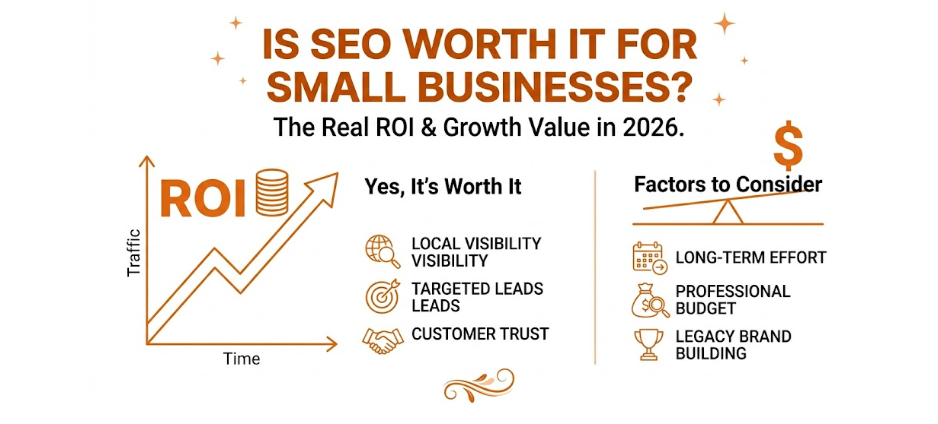
ROI is where the “worth it” conversation usually ends. For every $1 spent on SEO, the average business sees a return of about $22 in some cases, Compare that to the $2 return usually seen in paid search, and the winner is clear for long-term growth.
However, there’s a catch. SEO is a marathon. Most small businesses won’t see a positive ROI until months 6 through 12. If you need sales today to keep the lights on, SEO isn’t your primary tool—ads are. But if you want a business that is still thriving three years from now without a $10k monthly ad bill, SEO is the only way to get there.
The Real Cost of SEO for Small Business in 2026
One of the biggest hurdles is the price. How much does SEO cost? It’s a range, and anyone giving you a flat “$99/month” is probably selling you something that will eventually get your site penalized.
SEO Pricing Models
- Monthly Retainers: The most common. In 2026, expect to pay $1,500 to $5,000 per month for a professional, results-driven agency.
- Hourly Rates: Usually between $100 and $250 per hour. Good for audits or specific technical fixes.
- Project-Based: One-time fees for things like site migrations or local setup, ranging from $2,000 to $15,000.
Factors That Affect the Cost
- Competition: Ranking for “Lawyer in New York” is vastly more expensive than ranking for “Boutique Florist in Karachi.”
- Site Health: If your website is a technical mess, the first three months of your budget will go toward just fixing the foundation.
- Content Needs: Do you need two blog posts a month or twenty? High-quality content isn’t cheap.
Cheap vs. Professional SEO: The Danger Zone
It is tempting to go for affordable SEO services for small business that seem too good to be true. We’ve all seen the emails promising “First Page Rankings for $199!”
Here is the reality of “Cheap SEO”:
- Automated Content: They use old-school AI to churn out garbage that Google ignores (or penalizes).
- Toxic Backlinks: They buy links from “link farms” that can lead to manual penalties.
- Zero Strategy: They focus on “vanity keywords” that get traffic but zero sales.
Professional SEO, on the other hand, is a partnership. It involves deep keyword research, technical site audits, and building a brand authority that lasts. It costs more upfront because it requires actual human expertise and hours of manual work.
Is SEO Profitability a Guarantee?
No. Nothing in marketing is guaranteed. But you can stack the deck in your favor.
To make SEO profitable, you need to focus on conversions, not just rankings. It doesn’t matter if you rank #1 for a keyword if that keyword doesn’t lead to a phone call or a purchase. A professional strategist will look at your “Listed-to-Leased” pipeline (for real estate) or your “Click-to-Customer” journey to ensure the traffic you’re paying for is actually turning into revenue.
How to Choose an SEO Partner
If you decide that the benefits of SEO for small business outweigh the costs, don’t just hire the first person you see.
- Ask for Case Studies: Show me someone else you’ve helped in a similar niche.
- Avoid “Guarantees”: No one owns Google. If they guarantee #1, walk away.
- Focus on Transparency: You should know exactly what they are doing every month.
- Check their “Vibe”: Do they understand your brand? At beingextrovert.com, we always say that content should feel human and authentic. Your SEO should feel the same.
Final Verdict: Is It Worth It?
If you are looking for a “get rich quick” scheme, SEO is not worth it. You’ll be frustrated by the wait times and the technical jargon.
But if you are building a legacy, if you want to lower your customer acquisition costs over time, and if you want to be the authority in your niche—then yes, SEO is the most valuable investment you can make in 2026.
The best time to start was a year ago. The second best time is today.
Frequently Asked Questions: SEO for Small Business
- How long does it actually take to see SEO results in 2026? Honestly, it depends on your starting line. If you have a brand-new domain, you’re looking at 6 to 12 months to see significant traction. However, if you have an established site with some “authority,” a professional cleanup can show movement in as little as 90 days. In the age of AI search, “quality over quantity” is the rule—one viral, high-intent blog post can sometimes move the needle faster than 50 low-quality ones.
- Can I do my own SEO to save money? You can certainly handle the basics. If you’re tech-savvy, you can manage your own Google Business Profile, write your own blogs, and ensure your site isn’t a technical nightmare. But here’s the trade-off: SEO is a time-sink. As a small business owner, your time is often better spent on operations or sales. Most people find that “DIY SEO” leads to plateaus because they lack the expensive tools (like Ahrefs or Semrush) and the deep data analysis skills needed to beat professional competitors.